Three Centuries of Binondo Architecture: 1594-1898: A Socio-Historical Perspective by Lorelei D.C. De Viana


From the back cover:

Binondo is a district with a rich historic past. It was the most important arrabal outside of Manila during the Spanish colonial period, mainly because of its role in the socio-economic history of the Philippines. Its story revolves around the Chinese for whom the little hilly island of Minondoc and its adjacent caballeria by the beach were appropriated. But, it is also the story of the mestizos and the natives who made Binondo into a rich, multi-cultural society since its conception as a mission field in 1594 to the end of Spanish rule in 1898.
This book attempts to present the architecture that evolved in Binondo from 1594 to the end of Spanish rule in 1898 through a review of the district’s history. It tries to portray how society can affect the development of architecture and how architecture itself becomes a mirror of society.
Based on archival and secondary source researches, this study hoped to become a reference tool for architectural historians and students, and to all those who appreciate the importance of historic towns and districts as extant mementos from our rich cultural past.

Philippine Cultural Disasters by R. Kwan Laurel

Philippine Cultural Disasters by R. Kwan Laurel.  This book looks at different credentials-dispensing institutions and individuals in the Philippines, revealing their ideological coordinates in a world where commodity fetishism and capitalist accumulation have become the norm, even among writers and academics supposedly opposed to capitalism.  This collection shows us that issues surrounding the dominant culture and the dissent against it are subjects that must be discussed and debated vigorously.

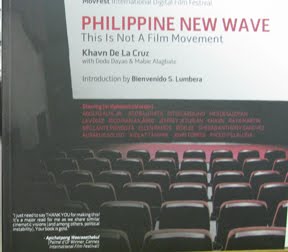
Philippine New Wave This is Not a Film Movement by Khavn De La Cruz

(from the Introduction by Bienvenido S. Lumbera) In this book of interviews and biographical sketches, editor Khavn De La Cruz and publisher Noel Ferrer allow us to meet 17 of the most articulate proponents of what they call the "Philippine New Wave". going over the remarks and accounts of their initial attempts at filmmaking, we realize that in spite of the demurrer in the title "This Is Not a Film Movement", we are confronted with a growing synergy that animate young filmmakers and heralds genuine change in the Filipino Film scene. So far, the limited accessibility of their output in the established exhibition venues has generated an audience of mainly young people, students and fresh graduates of urban colleges and universities. 
Nevertheless, it is a growing audience and one looks forward to a future when accessibility will cease to be a liability...

Ilustrado by Miguel Syjuco

(from the back cover)It begins with a body. On a clear day in winter, the battered corpse of Crispin Salvador is pulled from the Hudson River-taken from the world is the controversial lion of Philippine literature. Gone, too, is the only manuscript of his final book, a work meant to rescue him from obscurity by exposing the crimes of the Filipino ruling families. Miguel, his student and only remaining friend sets out for Manila to investigate.
To understand the death, Miguel scours his teacher's life, piecing together Salvador's story through his poetry, interviews, novels, polemics, and memoirs. The result is a rich and dramatic family saga of four generations, tracing 150 years of Philippine history forged under the Spanish, the Americans, and the Filipinos themselves. Finally, we are surprised to learn that this story belongs to young Miguel as much as to his lost mentor, and we are treated to an unhindered view of a society caught between reckless decay and hopeful progress.
Exuberant and wise, wildly funny and deeply moving, Ilustrado explores the hidden truths that haunt every family. It is a daring and inventive debut by a new writer of astonishing talent.

Sining ng Sineng Filipino Young critics circle

Sa ating panahon, hindi maikakaila na ang pang araw-araw na buhay ay nakapaloob sa palabas. Ang palabas na ito, bagama't namumukod-tangi bilang isang anyo ng espektakulo, ay nakahabi na sa pangkaraniwang gawi. Kalimitan, hindi na ito napapansin bilang isang puwersa na nagkakaroon ng saysay at kabuuan dahil dinaranas at inuunawa ng indibidwal at kolektibong pagtanggap.

A MOVIE ALBUM Quizbook by: Jessie B. Garcia

From the Introduction. This hefty assemblage of published anecdotes, unpublished reminiscences, historical facts and factoids, human interest sidelights, thumbnail biographies, random quizzes and assorted trivia about Filipino movies in general and some stray (though related) topics in particular that is awash with vintage photos and reproductions which you now hold in your hands was given rise to by a rather accidental (though somewhat serendipitous happenstance which took place more than two decades ago.

BANGON Antolohiya ng mga Dulang Mapanghimagsik nina Atienza, Lumbera, Zafra

Mapanghimagsik. Naiguhit na ng mahabang kasaysayan ng pakikibaka ng mga Pilipino ang walang-habas na paghawak ng armas upang magtanggol laban sa pananakop, pang-aapi at pagsasamantala. Nakaukit rin sa nakaraan at kasalukuyan ang iba't ibang paraan at antas ng paghihimagsik na isinagawa ng mamamayan. at ang kasaysayang ito ay matamang nakatala sa daan-daang mga dulang nagtataglay ng katangiang mapanghimagsik.