"Si Tatang at mga Himala ng Ating Panahon: Koleksiyon ng mga Akda ni Ricky Lee (Special Edition)"

     Kasama ang ilang maikling kuwento tulad ng Servando Magdamag at Kabilang sa mga Nawawala, mga artikulo, at ang screenplay ng Himala, ang CNN Viewers' Choice as Best Asia-Pacific Film of all time.
     Para sa bagong panahon, may mga dagdag na bagong retrato at drawings, at updates ni Ricky Lee sa ilang artikulo.
      Tampok ang photography nina Richard Gomez at Chanda Romero.

"Para Kay B" by Ricky Lee

NOW AVAILABLE!

"Me quota ang pag-ibig. Sa bawat limang umiibig ay isa lang ang magiging maligaya. Kasama ka ba sa quota?"

Blurbs from the back of the book:

"Weeks after reading the novel, Ricky Lee's characters continue to haunt me... [T]hey mesmerize, seduce, and provoke. There is hardly anything orthodox about them or the style in which their stories were written, but they are all so compelling because at the core of Ricky's work is the universal, irresistible yearning to find love—no matter how flawed, painful, or even dangerous—as long as it makes us hope that it's worth it. And it is. I wish I could film this novel, but not before I relish re-reading it again and again for its literary wizardry!" - Marilou Diaz-Abaya, Filmmaker and educator

 "Namumukod ang mga akda ni Ricky Lee sa lalim ng pagdalumat at mapangahas na teknik. Nangunguna rin siya sa masikap na paglalapat ng teoryang pampolitika sa kanyang mga binabasa at isinusulat." - Bienvenido Lumbera, National Artist for Literature

"Ricky Lee is one of the best Filipino writers ever, bar none. This long overdue novel will prove that he rules on the page as well as on the screen." - Ely Buendia, Musician

 "Hindi ko mabitiwan and nobelang ito maski ihing-ihi na ako. Minsan paumpisa na ang Boy & Kris at hinahanap na ako ni Kris, but I just couldn't stop reading. Ricky Lee is one of the best storytellers of this generation. Formidable and vulnerable at the same time. His fiction is truthful. Para Kay B is hilarious, painfully real, infinitely fascinating, riveting and is deftly crafter by a master. The characters are totally insane, just like you, me and Love." - Boy Abunda, Media personality

Three Centuries of Binondo Architecture: 1594-1898: A Socio-Historical Perspective by Lorelei D.C. De Viana


From the back cover:

Binondo is a district with a rich historic past. It was the most important arrabal outside of Manila during the Spanish colonial period, mainly because of its role in the socio-economic history of the Philippines. Its story revolves around the Chinese for whom the little hilly island of Minondoc and its adjacent caballeria by the beach were appropriated. But, it is also the story of the mestizos and the natives who made Binondo into a rich, multi-cultural society since its conception as a mission field in 1594 to the end of Spanish rule in 1898.
This book attempts to present the architecture that evolved in Binondo from 1594 to the end of Spanish rule in 1898 through a review of the district’s history. It tries to portray how society can affect the development of architecture and how architecture itself becomes a mirror of society.
Based on archival and secondary source researches, this study hoped to become a reference tool for architectural historians and students, and to all those who appreciate the importance of historic towns and districts as extant mementos from our rich cultural past.

Philippine Cultural Disasters by R. Kwan Laurel

Philippine Cultural Disasters by R. Kwan Laurel.  This book looks at different credentials-dispensing institutions and individuals in the Philippines, revealing their ideological coordinates in a world where commodity fetishism and capitalist accumulation have become the norm, even among writers and academics supposedly opposed to capitalism.  This collection shows us that issues surrounding the dominant culture and the dissent against it are subjects that must be discussed and debated vigorously.

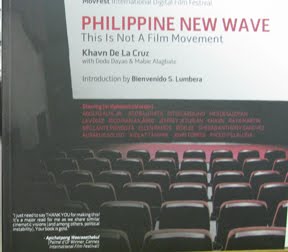
Philippine New Wave This is Not a Film Movement by Khavn De La Cruz

(from the Introduction by Bienvenido S. Lumbera) In this book of interviews and biographical sketches, editor Khavn De La Cruz and publisher Noel Ferrer allow us to meet 17 of the most articulate proponents of what they call the "Philippine New Wave". going over the remarks and accounts of their initial attempts at filmmaking, we realize that in spite of the demurrer in the title "This Is Not a Film Movement", we are confronted with a growing synergy that animate young filmmakers and heralds genuine change in the Filipino Film scene. So far, the limited accessibility of their output in the established exhibition venues has generated an audience of mainly young people, students and fresh graduates of urban colleges and universities. 
Nevertheless, it is a growing audience and one looks forward to a future when accessibility will cease to be a liability...

Ilustrado by Miguel Syjuco

(from the back cover)It begins with a body. On a clear day in winter, the battered corpse of Crispin Salvador is pulled from the Hudson River-taken from the world is the controversial lion of Philippine literature. Gone, too, is the only manuscript of his final book, a work meant to rescue him from obscurity by exposing the crimes of the Filipino ruling families. Miguel, his student and only remaining friend sets out for Manila to investigate.
To understand the death, Miguel scours his teacher's life, piecing together Salvador's story through his poetry, interviews, novels, polemics, and memoirs. The result is a rich and dramatic family saga of four generations, tracing 150 years of Philippine history forged under the Spanish, the Americans, and the Filipinos themselves. Finally, we are surprised to learn that this story belongs to young Miguel as much as to his lost mentor, and we are treated to an unhindered view of a society caught between reckless decay and hopeful progress.
Exuberant and wise, wildly funny and deeply moving, Ilustrado explores the hidden truths that haunt every family. It is a daring and inventive debut by a new writer of astonishing talent.

Sining ng Sineng Filipino Young critics circle

Sa ating panahon, hindi maikakaila na ang pang araw-araw na buhay ay nakapaloob sa palabas. Ang palabas na ito, bagama't namumukod-tangi bilang isang anyo ng espektakulo, ay nakahabi na sa pangkaraniwang gawi. Kalimitan, hindi na ito napapansin bilang isang puwersa na nagkakaroon ng saysay at kabuuan dahil dinaranas at inuunawa ng indibidwal at kolektibong pagtanggap.